"What time is it?" It sounds like the simplest question in the world, and yet it's also one of the most frequently searched phrases on the entire internet. Google processes billions of queries every day, and variations of "what time is it right now" consistently rank among the top. That's not surprising when you think about it. Time governs nearly everything we do — when we wake up, when we eat, when our meetings start, when the stock market opens, when a spacecraft launches, and when our favorite show airs live on the other side of the planet.
But the question hides a surprising amount of complexity. The exact time depends on where you are, which time zone you observe, whether daylight saving time is in effect, and how your device stays in sync with the rest of the world. A clock that's off by just a few seconds can mean a missed connection, a failed transaction, or a GPS coordinate that's hundreds of meters wrong. In this article, we'll unpack everything behind the deceptively simple question of what time it is right now — and show you how to find the exact, accurate time for any city on Earth.
How Your Device Knows the Exact Time
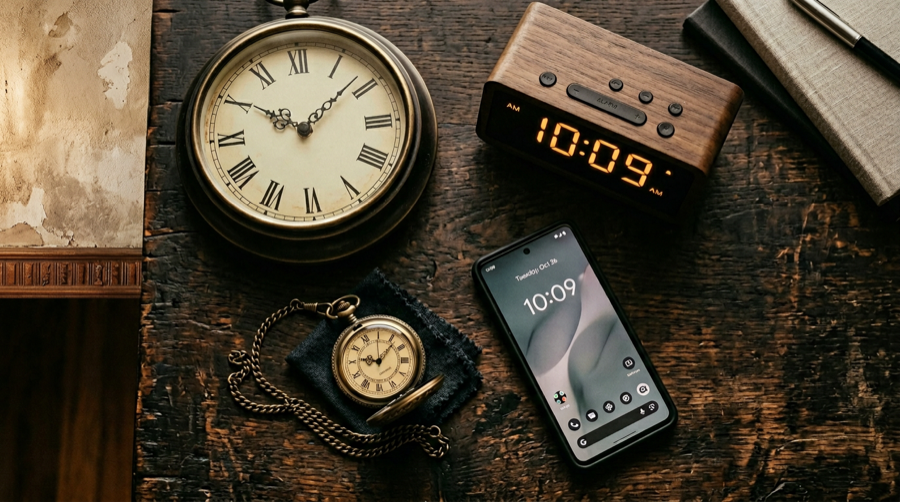
Have you ever wondered how your phone always displays the correct time, even when you travel across time zones or reset the device? The answer lies in one of the most quietly remarkable systems running behind the scenes of modern technology: the Network Time Protocol, better known as NTP.
NTP was first designed in 1985 by David Mills at the University of Delaware, and it remains one of the oldest internet protocols still in active use. Its job is simple in concept but extraordinary in practice — it synchronizes the clocks on billions of devices around the world to within a few milliseconds of Coordinated Universal Time (UTC). Your phone, your laptop, your smart TV, and even your car's infotainment system all rely on NTP or a close relative to keep accurate time.
The Role of Atomic Clocks
At the very top of the timekeeping hierarchy sit atomic clocks. These aren't the kind of clocks you hang on a wall — they're precision instruments that measure time by tracking the vibrations of cesium-133 atoms. A cesium atomic clock counts exactly 9,192,631,770 oscillations per second, and from that incredibly stable frequency, it derives the length of one second. The best cesium fountain clocks are accurate to about one second in 300 million years. Optical lattice clocks, a newer generation, push that figure to one second in 15 billion years — longer than the current age of the universe.
These atomic clocks are housed in national metrology laboratories around the world: the National Institute of Standards and Technology (NIST) in Colorado, the Physikalisch-Technische Bundesanstalt (PTB) in Germany, the National Physical Laboratory (NPL) in the United Kingdom, and dozens of others. Together, they contribute to the calculation of UTC, which is maintained by the Bureau International des Poids et Mesures (BIPM) in Paris. UTC is the time standard that everything else references.
From Atomic Clocks to Your Pocket
NTP works in a hierarchical structure called strata. Stratum 0 devices are the atomic clocks and GPS satellites themselves. Stratum 1 servers connect directly to those clocks and serve as the primary time sources for the internet. Stratum 2 servers synchronize with Stratum 1, and so on down the chain. By the time the time signal reaches your phone or computer, it has passed through two or three layers — but thanks to clever algorithms that account for network latency, the accuracy at your device is still typically within 1 to 50 milliseconds of UTC.
Smartphones have an additional trick: they also receive time signals from cell towers and, in many cases, directly from GPS satellites. GPS satellites carry their own atomic clocks and broadcast precise time signals as part of the positioning system. In fact, GPS is fundamentally a time-measurement system — your phone determines its location by calculating how long signals from multiple satellites took to arrive. So every time your phone shows you the current time, it's drawing on a network of atomic clocks orbiting 20,200 kilometers above the Earth.
Understanding Time Zones and Why They Exist
If the Earth didn't rotate, we'd all share the same time. But it does rotate — one full turn every 24 hours — and that rotation means different parts of the planet face the sun at different moments. When it's noon in London and the sun is high overhead, it's the middle of the night in Auckland, New Zealand, on the opposite side of the globe.
Before the 19th century, this wasn't much of a problem. Every town simply set its clocks to local solar time. Noon was whenever the sun reached its highest point in the sky, and nobody needed to coordinate with a city hundreds of miles away in real time. But the telegraph and the railroad changed everything. Suddenly, messages could travel faster than the sun, and trains needed coordinated schedules across vast distances. In the United States alone, there were over 300 local sun times in use by the 1880s, creating chaos for rail operators and passengers alike.
The solution came in 1884 at the International Meridian Conference in Washington, D.C., where delegates from 25 nations agreed to divide the world into 24 standard time zones, each spanning roughly 15 degrees of longitude. The Prime Meridian, passing through the Royal Observatory in Greenwich, England, was established as the zero-degree reference point. Time zones to the east of Greenwich are ahead of UTC (UTC+1, UTC+2, and so on), while zones to the west fall behind (UTC−1, UTC−2, etc.).

It's Not as Neat as 24 Slices
In theory, time zones are clean vertical bands circling the globe. In practice, they're anything but. Political borders, economic relationships, and practical considerations have bent time zone lines into some remarkably irregular shapes. China, despite spanning five geographical time zones, uses a single official time: UTC+8, Beijing Time. India uses UTC+5:30 — a half-hour offset that doesn't fit the neat one-hour increment pattern. Nepal goes further with UTC+5:45. And the Chatham Islands of New Zealand observe UTC+12:45, one of the most unusual offsets in the world.
Then there's Daylight Saving Time (DST), which shifts clocks forward by one hour in spring and back in autumn in about 70 countries. Not all regions within a country observe DST — Arizona in the United States, for instance, opts out, while the Navajo Nation within Arizona opts back in. These layers of complexity mean that the current time in any given city isn't just a matter of calculating its longitude; it requires up-to-date knowledge of local regulations, DST schedules, and political decisions that can change from one year to the next.
How to Check the Current Time in Any City
Given all this complexity, how do you actually find out what time it is right now in, say, Istanbul or São Paulo or Honolulu? You have several options, ranging from quick one-off checks to full-featured world clock dashboards.
Using Time.Global
Time.Global provides the current time for over 2,700 cities worldwide, updated in real time and sourced from the IANA Time Zone Database — the same database your operating system relies on. You can search for any city by name, and the result shows the exact local time, the UTC offset, whether DST is currently in effect, and the date. It's designed to be fast, ad-free, and accurate, which makes it particularly useful when you need a quick, reliable answer.
Beyond checking a single city, Time.Global lets you compare multiple time zones side by side, which is invaluable when you're trying to schedule a call between London, New York, and Singapore. The visual overlap makes it easy to spot the hours when all parties are likely to be awake and available.
Built-In Device Tools
Both iOS and Android phones have built-in world clock features. On an iPhone, the Clock app lets you add cities to a list and see their current times at a glance. Android's Clock app offers a similar feature. These are convenient, but they typically only show the cities you've manually added and won't surface additional context like DST status or UTC offset unless you dig into settings.
Desktop operating systems offer world clock widgets as well. On Windows 11, you can add up to two additional time zones to your system clock by going to Settings > Time & Language > Date & Time. macOS lets you display the time in the menu bar in various formats, and you can add a world clock widget to Notification Center. These tools are handy but limited in scope — if you need to check a city that isn't in your pre-configured list, a dedicated tool like Time.Global is faster.
Search Engines and Voice Assistants
Typing "what time is it in Tokyo" into Google, Bing, or DuckDuckGo will return an instant answer card showing the current local time. Voice assistants like Siri, Alexa, and Google Assistant can answer the same question spoken aloud. These are excellent for one-off queries, but they're less useful when you need to compare multiple cities or plan meetings across time zones.
Why the "Exact" Time Matters More Than You Think
For most everyday purposes, being off by a minute or two doesn't cause problems. Your meeting starts "around 10," and nobody panics if you walk in at 10:01. But there are entire industries where the exact time — down to the millisecond or even microsecond — is critical.
Financial Markets
High-frequency trading firms spend millions of dollars on infrastructure that shaves microseconds off their transaction times. The New York Stock Exchange timestamps trades to the nanosecond. When enormous sums of money can change hands in a fraction of a second, even a tiny discrepancy between two clocks can create arbitrage opportunities, regulatory violations, or disputed transactions. Financial regulators like the SEC and MiFID II in Europe mandate clock synchronization to within specific tolerances — typically 100 microseconds or tighter.
Aviation
Air traffic control depends on precise time to maintain safe separation between aircraft. Flight plans, departure slots, and approach sequences are all coordinated using UTC (called "Zulu time" in aviation). Pilots and controllers around the world speak the same temporal language, regardless of local time zones. A one-minute error in a flight plan could put an aircraft in the wrong position relative to other traffic, especially in crowded airspace like the North Atlantic corridor.
Medicine and Scientific Research
In hospitals, accurate time matters for medication schedules, surgical logs, and legal documentation. When a patient's condition changes rapidly, the medical record must reflect the precise sequence of events. In scientific research, experiments that measure the speed of light, the decay of particles, or the oscillation of molecules require time measurements far beyond what any wristwatch can provide. The LIGO gravitational wave detectors, for example, measure time differences of 10⁻²¹ seconds — a billionth of a trillionth of a second — to detect ripples in spacetime from colliding black holes.
Sports and Competition
The difference between a gold medal and a silver medal can be one hundredth of a second. At the Olympics, timing systems from companies like Omega and Swiss Timing measure finishes to the thousandth of a second and use high-speed cameras recording at 10,000 frames per second to confirm photo finishes. A marathon runner's official time depends on the accuracy of the starting gun signal and the timing mat at the finish line.
Everyday Life
Even outside these specialized domains, accurate time shapes daily routines in ways people rarely notice. Public transit systems run on synchronized schedules — a bus that's two minutes early effectively leaves passengers behind. Television and radio broadcasts are timed to the second. Online auction platforms close bidding at precise moments. And live sports betting operates on margins where a clock difference of a few seconds between a broadcaster's feed and the betting platform can be exploited. The modern world runs on synchronized time, whether or not we stop to think about it.
Common Time-Related Confusions
Even though we deal with time every day, certain aspects of timekeeping consistently trip people up. Here are some of the most common sources of confusion.
AM/PM Mistakes
The 12-hour clock format, used primarily in the United States, Canada, Australia, and a handful of other countries, leads to regular misunderstandings. Is 12:00 PM noon or midnight? (It's noon.) What about 12:00 AM? (Midnight.) These labels are counterintuitive because they break the pattern — 12:01 PM comes right after 11:59 AM, even though "12" sounds like it should belong to the other half of the day. Setting an alarm for 7:00 AM when you meant 7:00 PM, or scheduling a 12 PM meeting thinking you said midnight, are mistakes that happen far more often than people admit.
24-Hour vs. 12-Hour Format
Most of Europe, Latin America, Asia, and Africa use the 24-hour clock (also known as military time in the U.S.) as the standard. In this system, 1:00 PM is 13:00, 6:00 PM is 18:00, and midnight is 00:00. The advantage is unambiguous — there's no possible confusion between morning and afternoon. But people accustomed to the 12-hour system sometimes struggle with quick mental conversion. A handy trick: for any hour above 12, just subtract 12 to get the 12-hour equivalent. So 15:00 is 3:00 PM (15 − 12 = 3), and 21:30 is 9:30 PM.
Daylight Saving Time Surprises
DST transitions catch people off guard twice a year. In the spring, clocks "spring forward," and an hour disappears overnight — you go to bed at 1:59 AM and the next minute it's 3:00 AM. In the fall, clocks "fall back," and the hour from 1:00 AM to 1:59 AM happens twice. This creates genuine confusion for scheduling. If you set a meeting for 2:30 AM on the spring-forward night, that time literally doesn't exist. And the fact that different countries switch on different dates — or don't observe DST at all — means that the time difference between two cities can change several times a year. For roughly three weeks in March, for example, the time difference between New York and London is four hours instead of the usual five, because the U.S. springs forward before the U.K. does.
The International Date Line
The International Date Line runs roughly along the 180° meridian in the Pacific Ocean, and crossing it means jumping forward or backward by an entire day. Fly westward across the line and you skip ahead to tomorrow. Fly eastward and you return to yesterday. This concept is disorienting enough on its own, but the date line also zigs and zags around island nations for political reasons. Samoa famously switched from the east side of the date line to the west side in 2011, skipping December 30 entirely, because being a full day behind its major trading partners in Australia and New Zealand was costing the country business.
The Most Searched Cities for "What Time Is It"
Search data reveals clear patterns in which cities people most frequently want the time for. These tend to be major global hubs — financial centers, tourist destinations, and cities with large diaspora populations whose relatives frequently check in from abroad.
New York (EST/EDT — UTC−5/UTC−4)
New York consistently tops the list. As home to Wall Street, the United Nations, and one of the world's busiest airports, it's a city that the rest of the world constantly needs to coordinate with. Eastern Time is also the reference zone for most U.S. broadcast schedules, so "what time is it in New York" is often really a question about when an American TV show airs.
London (GMT/BST — UTC+0/UTC+1)
London sits at the historic heart of global timekeeping. Greenwich Mean Time originated here, and even though the modern standard is UTC (which is essentially the same thing for civilian purposes), London remains the baseline that most people think of when they hear "UTC." It's also a critical financial center — the London Stock Exchange's trading hours influence markets across Europe, Africa, and the Middle East.
Tokyo (JST — UTC+9)
Japan Standard Time is straightforward — no daylight saving time, no half-hour offsets, just a clean UTC+9 year-round. That simplicity, combined with Tokyo's role as a global technology and financial hub, makes it one of the most searched cities for current time queries. It's also a key reference point for anyone doing business in East Asia.
Dubai (GST — UTC+4)
Dubai has emerged as a global crossroads for business and tourism, particularly for travelers and companies bridging Europe and Asia. The UAE doesn't observe daylight saving time, so the offset stays at UTC+4 all year. This stability, along with Dubai's position as a major hub for Emirates airline, makes it a frequently searched time zone.
Sydney (AEST/AEDT — UTC+10/UTC+11)
Australia's largest city is the go-to reference for the Oceania region. Complicating things slightly, Australia spans multiple time zones, and different states have different DST policies — New South Wales observes DST while Queensland next door does not. So even within Australia, people sometimes need to look up the exact time in Sydney versus Brisbane.
Other Frequently Searched Cities
Rounding out the most popular queries are Los Angeles (UTC−8/UTC−7), Paris (UTC+1/UTC+2), Mumbai (UTC+5:30), Singapore (UTC+8), and São Paulo (UTC−3). Each represents a major regional hub where business, culture, and personal connections generate constant demand for time checks. You can look up the current local time in any of these cities — and thousands more — on Time.Global.
Tips for Keeping Accurate Time on Your Devices
Most people never think about whether their device's clock is accurate, and for the majority of situations, the default settings work fine. But if you've ever noticed your clock drifting by a minute or two, or if precise time matters for your work, here are some practical steps to ensure your devices stay in sync.
- Enable automatic time synchronization. On both Windows and macOS, make sure your system is set to sync time automatically. On Windows, go to Settings > Time & Language > Date & Time and toggle 'Set time automatically' to on. On macOS, go to System Settings > General > Date & Time and enable 'Set date and time automatically.'
- Check your phone's time settings. On iPhone, go to Settings > General > Date & Time and turn on 'Set Automatically.' On Android, it's usually under Settings > System > Date & Time. If you travel frequently, this ensures your phone updates its time zone as you move.
- Use a reliable NTP server. If you manage servers or need high-precision time, configure your devices to sync with a reputable NTP pool like pool.ntp.org or a national time service like time.nist.gov (NIST) or time.google.com (Google). These servers provide time accurate to within a few milliseconds.
- Be aware of your device's quartz drift. The quartz crystal oscillator in a typical computer or phone drifts by about 1 to 2 seconds per day without correction. That's why regular NTP synchronization matters — without it, your clock could be off by a full minute within a month.
- Use a world clock dashboard for multi-zone awareness. If you regularly work with people in different time zones, bookmark a world clock tool like Time.Global and keep it open in a browser tab. Being able to glance at multiple city times simultaneously is far more efficient than converting time zones in your head.
A Brief History of Asking "What Time Is It?"
The question "what time is it" is one of the oldest in human civilization, even if the tools for answering it have changed beyond recognition. Ancient Egyptians used obelisks and shadow clocks as far back as 1500 BCE. Water clocks (clepsydras) allowed timekeeping at night or on cloudy days. The medieval era brought mechanical tower clocks to European cities, and for the first time, a community could share a single time reference — the sound of the bell.
Pocket watches arrived in the 16th century, making personal timekeeping possible for the first time. Wristwatches became widespread in the early 20th century, initially among soldiers in World War I who needed to coordinate operations without fumbling for a pocket watch. Quartz watches revolutionized accuracy in the 1970s, and by the 1990s, cell phones began to replace watches as the default time-checking device for many people.
Today, the most common way to check the time is to glance at a smartphone. But the infrastructure behind that simple glance — the atomic clocks, the NTP servers, the GPS satellites, the IANA time zone database — is a marvel of global coordination. When you ask "what time is it right now," you're invoking a system that stretches from cesium atoms in a laboratory in Colorado to a network of satellites orbiting 20,000 kilometers overhead to an internet protocol designed in 1985 to a database maintained by volunteers who track every time zone rule change on the planet. All so you can see "10:42 AM" on your screen and trust that it's right.